
Zero suicides is a realistic target
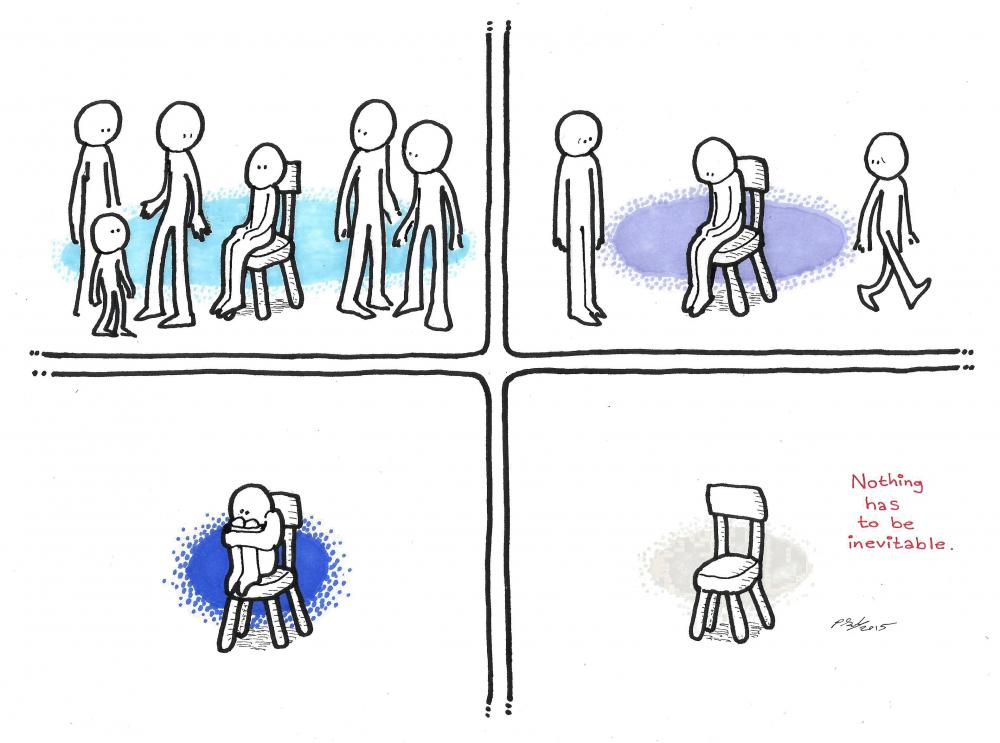
Fergus Cumiskey, MD of Contact NI, speaks to Scope about how a change in attitude could make huge improvements in Northern Ireland's high rate of those at risk of dying by suicide.
The front line of modern suicide prevention care requires belief, according to one of Northern Ireland's leading crisis counselling providers.
Not faith - belief in what you haven't or cannot see or understand - but a much more modest thing, belief in the evidence of some "courageous" programmes from around the world in recent years.
Some "abiding myths" are preventing a system-wide change, with far more ambitious targets and the potential for immediate improvements in suicide rates.
Ultimately, and most importantly, the consensus is not what it should be: that every single incidence of suicide is preventable.
All this is the view of Managing Director of Contact NI, Fergus Cumiskey. Speaking with Scope, he said the prevailing view among clinicians is founded on long-standing misconceptions.
"There is an abiding and hard-to-shift belief in communities, and also in clinical care, that if someone chooses to die by suicide then there is nothing anyone can do about it.
"This age old myth suggests that people ‘choose’ to die, whereas recent studies engaging people who have survived near lethal suicide attempt, were in fact ambivalent until the last moment of life, weighing up the pain of living with yearning for relief from that pain and despair.
"People considering suicide report feeling isolated and a burden to loved ones leading to acute ambivalence about commitment to life. This can quickly lead to silent suicide planning and the sense that all other choices are off the table. Suicide is not a rational choice, more a sense of no choice at all."
Contact is currently running a Zero Suicides campaign which wants Health and Social Care leaders in Northern Ireland to adopt the view that zero suicides is the only legitimate target for providers - and a realistic one.
Preventable
Mr Cumiskey’s central message within the campaign is that all suicides are preventable.
Ambivalence is, in most circumstances, thought of as a gentle state of equivocation, rather than a destablising force promoting despair and personal crisis. But ambivalence about the value of one's own life is an extremely risky distortion.
Unfortunately, however, the actions of loved ones have a strong tendency to buttress this mindset rather than work against it - and represent yet another part of society's misconceptions about suicide and associated mental health issues.
Dr Christabel Owens is a senior research fellow at the University of Exeter, specialising in the study of suicide.
She spoke at Contact's recent 2015 conference about how friends and families can, despite the very best intentions and even an intuition that something needs to be done, behave in a way that does not help the perilous circumstances of the person they care about.
Dr Owens talked "of the importance to follow one’s intuition when assessing suicide risk for a family member, taking the risk to be impolite and ask the difficult questions when suicidal ideation and suicide planning may converge."
Mr Cumiskey said that Dr Owens has recently completed a qualitative study into the experiences of families where a relative had died by suicide and found that close family members consistently knew there was a problem but often act in a way that is intuitive but not necessarily helpful.
"Research over the years with families who have had someone die by suicide shows that, uniformly, everyone in the family could see something coming but could not pinpoint what it was. In the aftermath they are then able to put things together.
"Part of the problem of course is that people don’t like to talk about these uncomfortable issues. Those at risk of suicide will often feel like a burden to those around them and will not want to discuss how they are feeling.
"But not only was the person in distress, isolated and experiencing a sense of being a burden to others, but those who loved them also are isolated from them, and are willing to do anything to protect the relationship they have with the person. People are desperate not to say the uncomfortable thing that might push a loved one away or threaten the relationship at a pressured time.
"Further, the loved ones of the person at risk might not want to raise issues because they are worried this can make things worse, instead they often bend themselves to fit around the problem, thinking that is the best thing to do - all the more so when there’s depression, or a very poor reaction to a relationship break up or work worries.
"Both the family and the person at risk and who ultimately died by suicide are therefore isolated, both feel they could burden the other by speaking about it."
He agrees with the conclusion of Dr Owens that being bold and doing the uncomfortable thing is therefore the much better option - "Whatever you say, say something."
The narrative of suicide described above also gets to the heart of its preventability - people, both clinicians and in society generally, of course need to be educated more about not just how to deal with these issues, but also about the extent to which they can be assuaged - a fact that is borne out by evidence.
Evidence
One of the huge successes cited by Contact and others is the Henry Ford Health Programme in Michigan, US.
As far back as five years ago, some of the amazing successes they have recorded were being publicised - which raises questions about why this attitude has not been replicated everywhere by now, especially somewhere like Northern Ireland, where suicide is such a problem.
This has been made all the more stark by the World Health Organisation making an official declaration that suicide is preventable - precisely what Contact's campaign is saying - last September, a development Mr Cumiskey says is "massive".
At the same time, another local man is taking the lessons of Henry Ford and other modern suicide research and implementing it in the UK.
Joe Rafferty is the CEO of Mersey Care, a health trust in England, and he has now made zero suicides a flagship target for that area - believing the zero rate can be achieved within five years.
Currently Northern Ireland sees an average of around six suicides every week.
The evidence shows that, with the right approach, suicide can be prevented - and we can save ourselves from the associated heartbreak and loss.
To start with, it just needs some belief.
Share Article...
Join the Conversation...
We'd love to know your thoughts on this article.
Join us on Twitter and join the conversation today.
Join Our Newsletter
Get the latest edition of ScopeNI delivered to your inbox.

 One final article – a goodbye
 A story to inspire ...
  The shameful waste of our money
  Fund's new strategy unveiled
 The true cost of deprivation and division
  An ancient key to longevity