
Savile, child abuse and the BBC
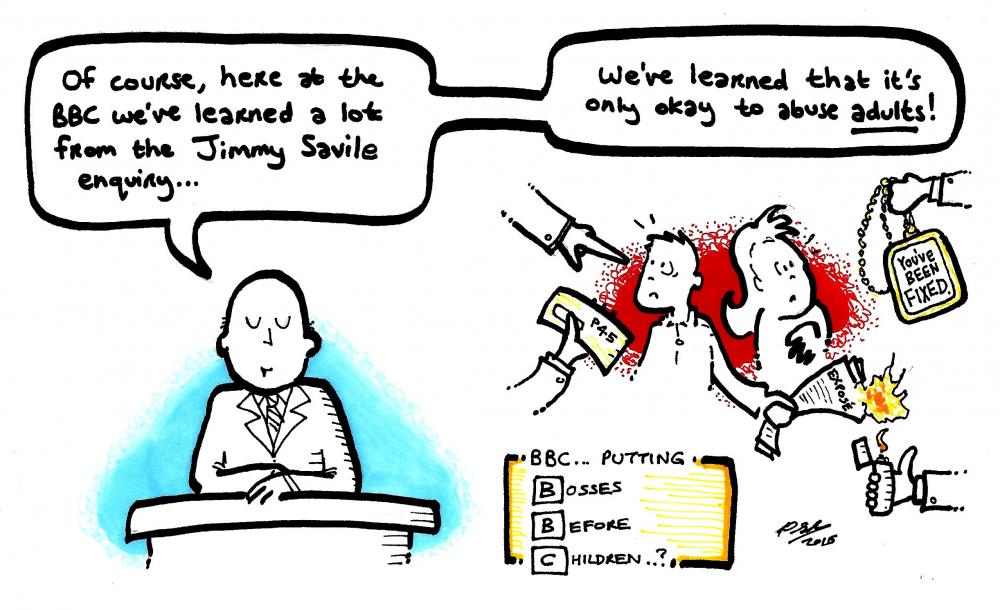
It has been a truly awful week for the BBC with the publication of two separate reports into its treatment of the Jimmy Savile and Stuart Hall affairs.
Director General Tony Hall issued a robust response, saying all the right things, yet questions still linger both about the BBC and, much more broadly, the extent of the abuse of children both in the past and present and the lengths to which various institutions have been prepared to go to cover this up when they perceived that their own interests were more important than those of the children involved.
It is not just about the BBC of course. The week also witnessed the conviction of six men for appalling sex crimes committed against young girls in Rotherham which raises disturbing questions about the responses of both the local authority concerned and the South Yorkshire police.
There is a recurring pattern here. Much of this abuse has been committed by people who by dint of their religious standing, ethnicity, status within the political establishment, or their celebrity were able to put themselves effectively beyond the law. Many cases also are characterised by cover-ups and or police inaction and a questionable attitude to both victims and whistleblowers.
Dame Janet Smith in her report on Savile states that “Savile would gratify himself whenever the opportunity arose and I heard of incidents which took place in virtually every one of the BBC premises at which he worked,”
“I conclude that certain junior and middle-ranking individuals were aware of Savile’s inappropriate sexual conduct in connection with his work for the BBC,” Smith said. “However, I have found no evidence that the BBC, as a body corporate, was aware of Savile’s inappropriate sexual conduct.”
Smith found that staff did not pass their complaints up the chain of command for fear of reprisals and a culture at the BBC that made it difficult to “rock the boat”.
Yet she did interview 117 people who had worked with Savile at the BBC who said they had heard rumours that he was a paedophile.
And her own report states that Savile assaulted two young girls live on Top of the Pops. The show was taped and the relevant clip is widely available on the web. It seems clear when watching it that Savile is assaulting one of the girls concerned. If senior management were not aware of the incident they should have been: it was broadcast live on their own network.
The DJ Andy Kershaw who also gave evidence told BBC Radio 4 this week that when he joined the corporation he was specifically warned about Savile, as a nasty piece of work and told of his appetite for young girls. He was warned to stay away from him, which he did.
Savile’s reputation as a sexual predator was not confined to the BBC it was spoken about across the entertainment industry and within media circles. The only people apparently unaware of this were senior management at the BBC.
Smith’s comments about the climate of fear at the BBC and its culture has special resonance for those of us who followed the Newsnight affair. Shortly after Savile’s death in 2012 reporter Liz MacKean and her producer Meirion Jones carried out an investigation into Savile’s sexual activities. The programme was never broadcast However a tribute to Savile was.
Reporter MacKean says she was forced out of the BBC: “When the Savile scandal broke, the BBC tried to smear my reputation. They said they had banned the film because Meirion and I had produced shoddy journalism. I stayed to fight them, but I knew they would make me leave in the end. Managers would look through me as if I wasn’t there. I went because I knew I was never going to appear on screen again.”
Jones has also left the BBC and now describes himself as an “investigative journalist for hire.”
However those responsible for blocking the broadcast have done okay. Helen Boaden was head of news. She claimed at the time never to have heard any “dark rumours” about Savile and when briefed by then Newsnight editor Peter Rippon about the Savile story said: “When I asked him what that was he said: 'Jimmy Savile and teenage girls'. And since this, I think, was about three weeks after Jimmy Savile had died I thought it was one of those slightly tabloid-esque stories involving groupies.”
She is now Director of BBC England and BBC Radio. Rippon was moved from Newsnight to run the BBC’s archive.
Nobody is suggesting that Boaden or Rippon did anything other than act in good faith. However their decisions were clearly flawed and yet the two journalists who exposed Savile have left the BBC. This did not happen in the 1970s but in the very recent past.
Tony Hall has promised change. Yet there is still a climate of fear at the BBC It is not an easy place to get to work in. Standards are high, competition intense and as cuts bite there are many who are in fear of their jobs. This exists from top to bottom. The Beeb has an uneasy relationship with government and future funding is a massive issue.
Smith report also states:
“The evidence I heard suggested that the talent was treated with kid gloves and rarely challenged,” she said. “The BBC should leave members of the talent in no doubt as to the standards of behaviour expected of them.”
Sadly celebrity culture has strengthened since the days when Savile stalked the country with a grubby mattress in the back of his camper van. “Talent” is regarded as even more precious, to the extent that to this day the BBC refuses to say how much its top stars get paid.
Changing an organisation’s culture is easier said than done and a very long process. If Mr Hall is in any doubt about that he should ask the pope.
Share Article...
Join the Conversation...
We'd love to know your thoughts on this article.
Join us on Twitter and join the conversation today.
Join Our Newsletter
Get the latest edition of ScopeNI delivered to your inbox.
 One final article – a goodbye
 A story to inspire ...
  The shameful waste of our money
  Fund's new strategy unveiled
 The true cost of deprivation and division
  An ancient key to longevity